Try →

OAH FHIR
add-on
Track 7
IEEE 2026

StreamProof grades every citizen stream report from A to D with reasons anyone can read, lets neighbours and experts make it stronger, and writes it into OneAquaHealth’s own FHIR standard with a rule for what each trust level may be used for.

Built on
1 — 2
HL7 Europe OneAquaHealth FHIR guide+OAH FHIR guide+
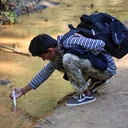
A hand touching a clear stream
1

(Product)

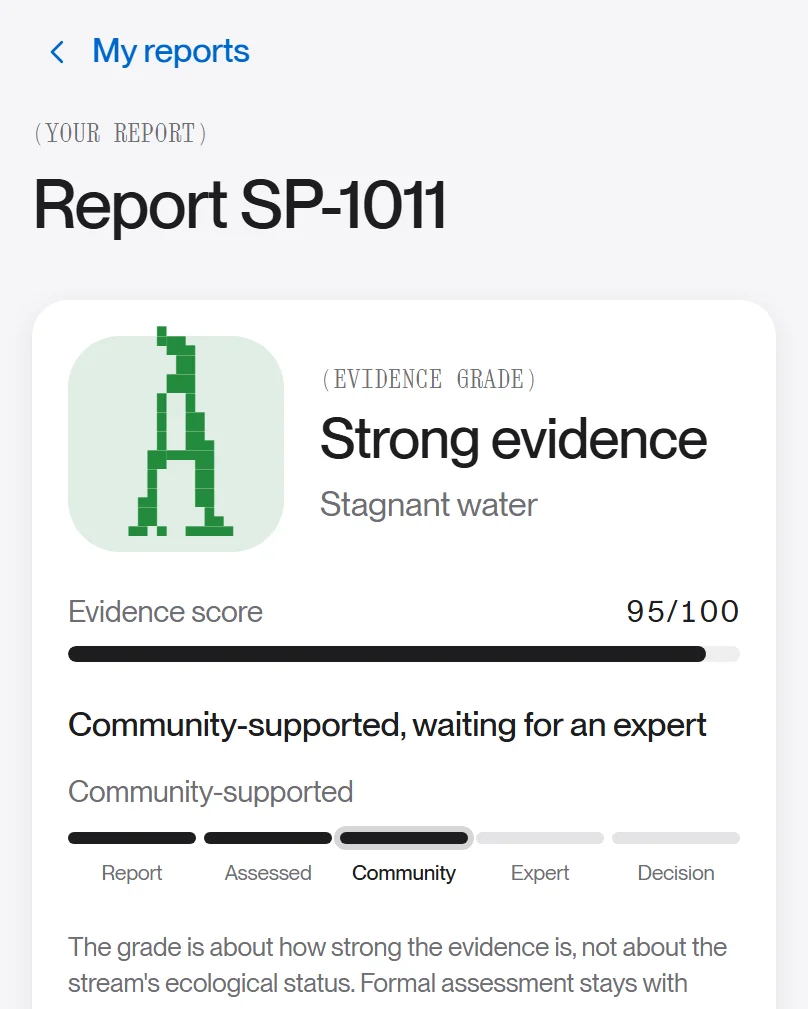
StreamProof report card: grade A, strong evidence

Citizen app

A report takes about a minute: a photo, the signs you can see, done. It comes back with a grade from A to D, the seven reasons behind it, and what would make it stronger. An “all clear” earns the same credit as a problem, so the map shows healthy streams too.

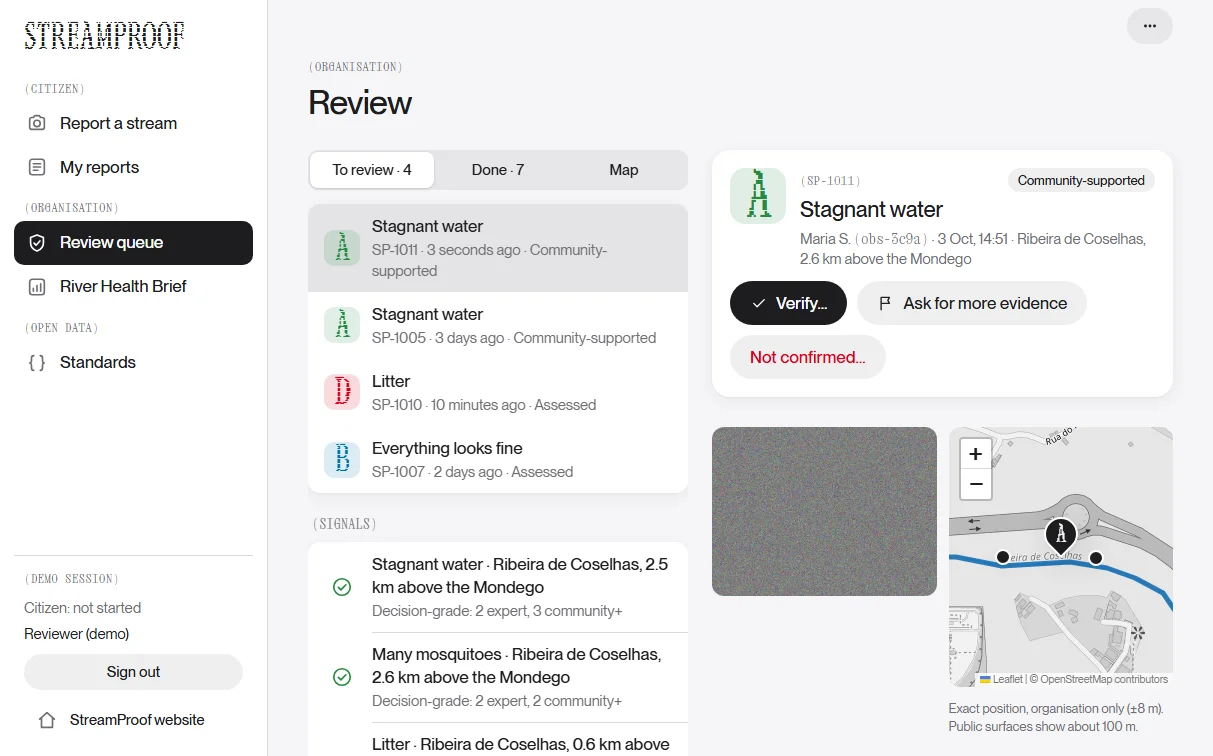
StreamProof review queue with a report open

Org portal

Reviewers see only the reports that need them, with nearby evidence and a mission 400 m upstream when proof is thin. A gate refuses any export the trust level doesn’t permit.

A forest stream over mossy rocks
2

(How it works)

Report, grade, strengthen, release. Rules and the community check most reports and experts check the flagged ones, so reviewers spend their time only where it matters.
1
Report what you see
1
1 — 4
Report what you see

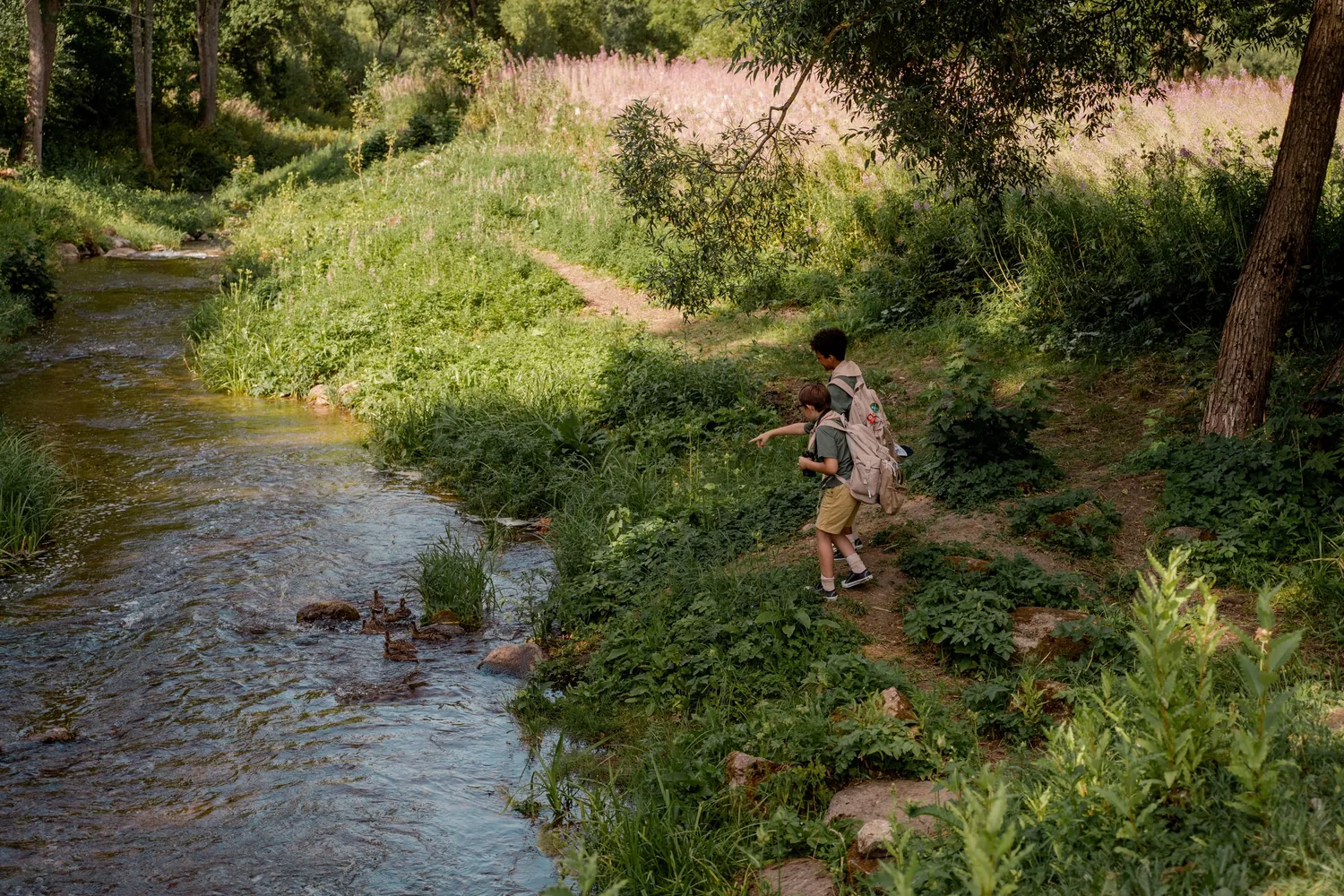
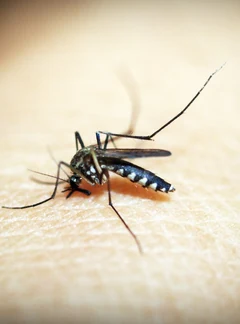
1A citizen or a school group takes a photo and taps the signs they can see: scum, foam, a bad smell, dead fish, mosquitoes, stagnant water, an oily sheen, sewage or litter, or “everything looks fine”. The public location is coarsened to about 100 m and the reporter stays pseudonymous.

2Seven readable checks (photo, time, GPS, on-stream position, nearby reports, weather and track record) give a grade from A to D, each with a reason in plain words. The grade measures evidence quality, never ecological status: formal assessment stays with OAH field protocols.

3Independent neighbours corroborate, counted as people rather than reports, under a daily cap. An expert can verify directly at a rural site. Missions send volunteers to reaches with few reports, so evidence doesn’t only follow well-walked areas.

4A permitted-use gate reads a published FHIR rule file before anything leaves. Expert-verified records are written in the OAH guide’s format, and decision-grade evidence can raise an advisory that a site “may warrant inspection”, never a diagnosis.

Want to see it?
Try →

A stream running through moorland
3

(What it adds)

OneAquaHealth’s FHIR guide records what was observed, but not how far it can be trusted or what it may be used for. Here’s what StreamProof adds.
A grade with reasons

A to D from seven checks a citizen can read, mapped to the ISO 19157 data-quality elements: positional accuracy, temporal quality, thematic accuracy, completeness and logical consistency.

A rule for every use

What each trust level may be used for (org dashboard, public map, OAH export, certificate, advisory, DipteraCAST) is published as a FHIR CodeSystem that the gate loads at startup.

Records in OAH’s own format

Profiles derive from ObservationIndicatorsOah and LocationOah: the OAH indicator goes in the code, the citizen’s sign in the value. Six of nine signs map to OAH concepts; the other three are proposed as new ones.

Evidence that goes somewhere

A River Health Brief with measures matched from the OAH Catalogue of Measures, expert-verified Diptera presence and absence for DipteraCAST, and a signed certificate for every contributor.

A city river and bridge, seen from above
4

(Who it serves)

See in plain words why a report got its grade and what would make it stronger. An all-clear counts as much as a problem, and every contributor gets a signed record.

Citizens and schools

Citizens and schools

Report · track · certificate

5

(Why)

(EST.2026)

A rumour and a verified report look the same to a computer. StreamProof tells them apart inside OneAquaHealth’s own FHIR standard, so cities can act on what citizens see.

A rocky forest stream

Every stream counts

(Track 7)

Trust in citizen-science data is an old problem. Alabri & Hunter (IEEE e-Science 2010) combined quality checks with trust metrics, and Baker et al. (2021) reviewed 259 schemes and recommended layered verification. StreamProof implements that and adds a machine-readable rule for what each trust level may be used for, carried inside standard FHIR records.

It is designed for OneAquaHealth’s five cities (Benevento, Coimbra, Ghent, Oslo and Toulouse) and to outlive the project: the add-on is proposed as a module for the HL7 Europe OAH guide, and the rule files stay open.

6

(FAQ)

Everything a reviewer asks before trusting a report.

Community agreement isn’t the same as accuracy for hard-to-identify taxa, and a research-grade label doesn’t say what a record may be used for. StreamProof adds both: reasons for the grade and a rule for each use.

Accuracy

They scored trust. StreamProof turns trust into enforceable use rules and carries them inside a health-data standard, following the layered verification Baker et al. (2021) recommend.

Prior art

OneAquaHealth’s own data guide, maintained by HL7 Europe, is FHIR, and its health partners already speak it. In One Digital Health, stream data and health data travel in the same format.

Standards

They are configurable defaults, meant to be calibrated with OAH ecologists. A calibration report publishes the current limits and the honest numbers behind them.

Calibration

It takes different people, spread in time or place, under a daily cap and weighted by track record, plus an expert for decision grade. The threshold counts people, not reports.

Independence

Reporters are pseudonymous, FHIR records carry a location coarsened to about 100 m, identities sit in a separate vault, and erasure keeps the signed evidence valid. A real deployment still needs review by a data protection officer.

Privacy

Not yet, and we say so. StreamProof is designed to sit behind OneAquaHealth’s Citizen Science App as a trust layer, with this app as a reference client. For DipteraCAST it exports verified ground truth; the model itself isn’t public.

Honesty

An Ed25519 signature over a de-identified hash is tamper-evident and simple, and it still lets a person’s identity be erased. A blockchain would add cost without adding trust here.

Integrity
Open

Got more questions?

See the FHIR add-on →